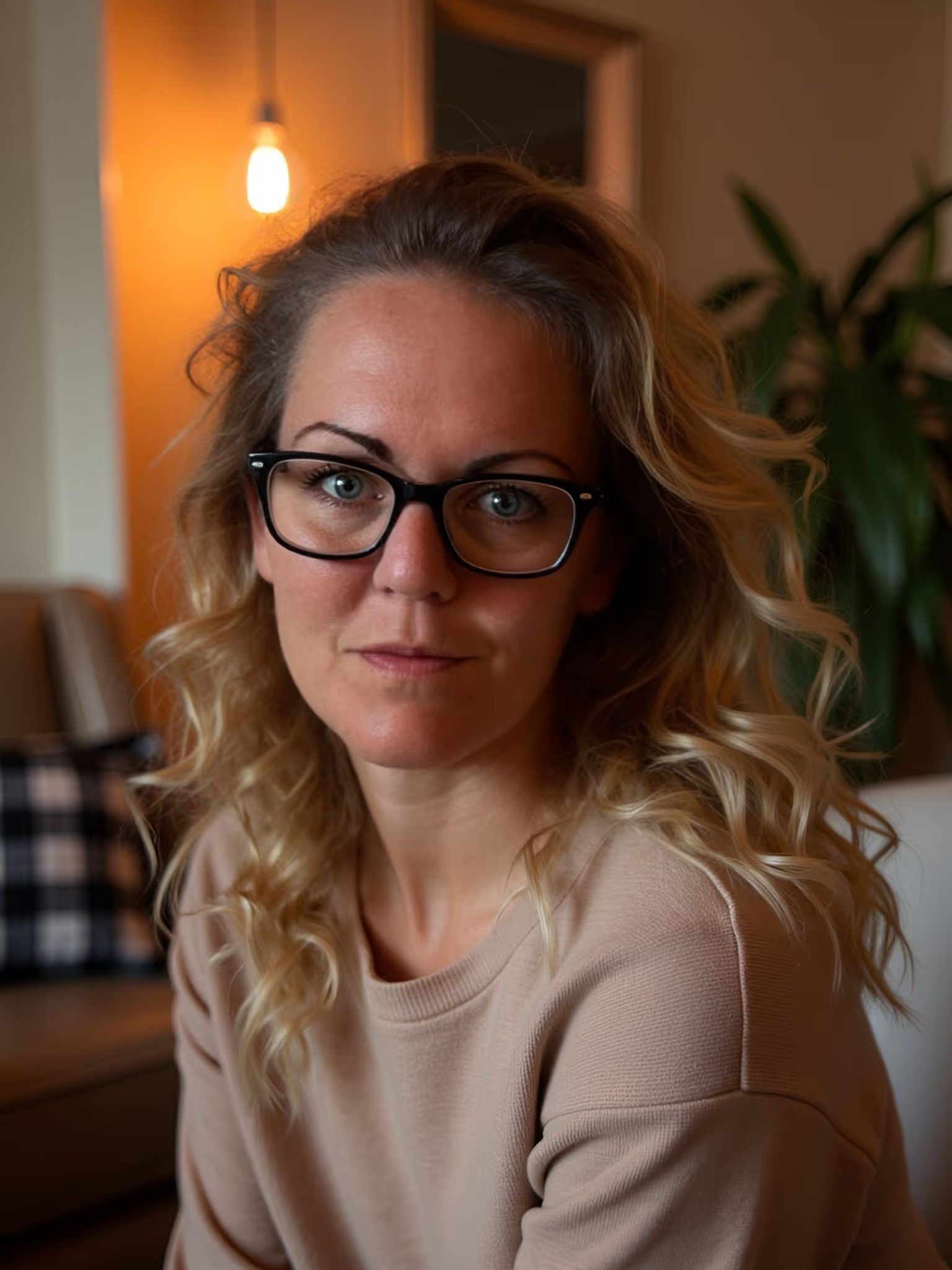
Natascha Taglöhner

Psychologist, (e)motion coach

homepage

Often, it takes very little to shift into entirely new, more hopeful and fulfilling paths.

Do you sometimes feel as though your emotions are in control — rather than you guiding them? The key to greater wellbeing, emotional balance and health lies in emotional intelligence. The word itself already holds the essence: (e)motion. Our emotions and our movement are deeply connected within us.

“Emotion” reflects our inner world of feeling and experience, while “motion” represents movement. And where better to explore this connection than in the mountains around Oberlech — a place where emotions can rise and settle in equal measure.

Much of our emotional processing happens automatically. Yet within this automation, a great deal of potential remains hidden — for personal growth, for our relationships and for our overall wellbeing.

Emotional intelligence has long been recognised as a foundation for meaningful communication, social interaction, resilience, wellbeing and health. It forms the bridge between our rational thinking and our emotional impulses.

This is where our programme begins. This inner bridge is not fixed — it can be shaped and expanded. Through techniques from clinical psychology, mindfulness practices and personal development, we learn to perceive our emotions more consciously, making them more accessible and easier to navigate.

In our peak(e)motion program, we work precisely with this inner realignment. Together, we expand our capacity for conscious choice and awareness.

Step by step, we move towards greater clarity, mindfulness and connection — with ourselves, our surroundings and our relationships, both personal and professional.

Different focus programmes are available, allowing each journey to unfold in its own way.
My services for you in Goldener Berg

Self-perception (emotional self-confidence)

+

Strengthening self-reflection:
Only those who understand their emotions can consciously guide them.

The self-reflection programme:
Combines elements of clinical psychology, sociology, mindfulness practice and nature-based approaches to create a holistic and natural access to your inner experience. It leads you back to the roots of your needs — exploring what drives you, where your perceptual filters are active and with which expectations you perceive and ultimately shape your world.

Duration per session: 60–90 minutes | €198

Self-regulation (dealing with emotion)

+

By following this programme path, we move from being unconsciously driven by our emotions in everyday life towards a key new skill — one that supports greater wellbeing, relaxation and health, and can be used in a conscious and productive way.

The self-regulation programme (managing emotions):
Forms the foundation for improving how we relate to our emotions. At its core, this programme helps shift from automatic, impulsive reactions towards a more conscious and aware response.

This means learning to perceive emotions more clearly, recognise them for what they are and name them. In doing so, a new, more conscious bridge is created — one that allows, often for the first time, a deliberate choice about whether and how to respond to an emotion.

This response can be shaped across different levels: in facial expression, body language, emotional experience and cognitive thought. All of these channels can be guided — and learned.

This forms the foundation of programme 2.

Duration per session: 60–90 minutes | €198

Empathy and social skills

+

— means perceiving and understanding the person in front of you, and developing a healthy way of relating, communicating and resolving conflict.

The “Developing Empathy” programme:
Brings together different perspectives on human interaction — with a focus on the other person. It is based on insights from neuroscience, human genetics, sociology, communication and behavioural science.

Here, the perspective gradually shifts from yourself towards the person you are engaging with. You learn step by step to perceive others more clearly, to understand them more deeply and to differentiate more precisely in your perception.

The foundation lies in observing facial expressions, body language, tone of voice, as well as visible behaviour and movement. From these, a wealth of information can be gathered. In this programme, these signals are made visible and your ability to perceive them is strengthened.

“Training emotional intelligence means becoming more aware of your own feelings — and more empathetic towards others.”

Duration per session: 60–90 minutes | €198

Breath(e)motion

+

Refers to conscious, guided breathing techniques designed to regulate the nervous system, reduce stress and enhance both physical and mental wellbeing.

It serves as a bridge, helping to bring our experience back to a more natural state of being. Whenever possible, these sessions take place in a natural setting — outdoors, in nature.

Through intentional, often connected breathing, the vagus nerve is stimulated and the parasympathetic nervous system is activated. This leads to deep relaxation, improved sleep and increased energy.

“Breathwork is more than just breathing — it is a bridge to meditation and brings the mind into the present moment.”

Duration per session: 60–90 minutes | €198

Preventive health promotion through clinical-psychological measures

+

– zielen darauf ab, die psychische Gesundheit zu stärken, Risikofaktoren zu minimieren und das Auftreten von psychischen Störungen und Krankheiten zu verhindern.

Stressmanagement-Training

gezieltes Üben von Entspannungstechniken

Achtsamkeits-Training

Förderung des gegenwärtigen Bewusstseins

Diagnostik

zur Abklärung und Analyse psychischer Funktionen, Fertigkeiten und Fähigkeiten.

Kognitive Umstrukturierung: Veränderung dysfunktionaler Gedankenmuster

Selbstinstruktionstraining: Anleitung zur Selbstbeeinflussung

Expositionstraining: Konfrontation mit angstauslösenden Reizen)

Anleitung zur Selbstbeeinflussung

  • Training sozialer und emotionaler Kompetenzen: Verbesserung des Umgangs mit anderen und eigenen Emotionen
  • Inneres Kind-, Teile-Arbeit: Arbeit zur Selbstregulation
  • Entspannungsmethoden: Atemtechniken, Body-Scann, Visuell-Imaginative- Reisen, Geruchsreisen
  • Brainspotting, Gesprächstherapie: Methode zur Verarbeitung traumatischer Ereignisse
  • Klinisch-psychologische Schmerzbehandlung: spezielle Ansätze für chronische oder übermäßige Schmerzen
  • Neuropsychologische Rehabilitation: Gedächtnistraining und Förderung von Funktionen der kognitiven Leistungsfähigkeit, präventiv oder nach kognitiven Einbußen

Die Auswahl der Methode erfolgt nach diagnostischer Abklärung und zielt auf die Veränderung belastender psychischer Zustände ab. Bei krankheitswertigen Diagnosen sind Kostenübernahmen über die Krankenkassen möglich.

Dauer je Einheit: 60-90 Minuten | € 198

What is increasing emotional competence useful for?

  • Experience less stress and fewer high peaks
  • Increasing wellbeing; improving communication skills
  • More differentiated perception of one's own emotions and needs
  • What do I really want?
  • What drives me?
  • Better conflict resolution ability
  • Faster, improved ability to process emotions well and suppress them less
  • Improving the co-regulation of the other person
  • Improving the ability to relax
  • Improving health quality
  • Improving sleep quality

Natascha Maria Taglöhner

About who I am.

I have always been fascinated by the movement and the question of what drives people most fundamentally and ultimately really at the grassroots level.

In the course of my academic education, emotion (e) motion), i.e. colloquially “the feeling”, increasingly emerged as a fundamental driving force or as a fundamental motor for all human action, every decision and as the cornerstone of every motivation necessary for movement (motion).

It is therefore the feeling, the emotion that makes us move, i.e. in “motion” and this is exactly the cornerstone of my type of consulting, my practice, and the mount (e) motion coaching programs offered.

While studying psychology in Innsbruck, I worked in various counseling facilities at the Innsbruck Clinic.

During the corona pandemic, my area of activity has shifted from an economic, neurological focus to a clinical-diagnostic focus. At the same time, I supervised emergency personnel before and after assignments in order to keep them fit in their well-being, health and operational capacity. I have experienced all too well in my own family environment what it can mean for emergency services and their families when left alone, they have to deal with unimaginably terrible experiences. That was my way into emergency and trauma psychological treatment. This is now also one of the cornerstones of my practice.

Hiking in the mountains gives me a personal balance. For me, mountains have always meant freedom without having to fulfill a certain role or expectations. Not to have to meet deadlines or performance, but to be simple in its most original, basal form and, above all, enough to be yourself without function and roles.

My insatiable thirst for knowledge leads me, as often as possible, to continuing education and training in a wide variety of psychological and medical topics in order to be able to incorporate and use these findings from psychological, physical, naturalistic and pharmacological areas in my treatments and programs.

As a result, no treatment is the same, since, like human development, it is constantly evolving through new findings and even though it sometimes barely noticeably progresses, it never stands still.